Choosing a card format is not only a graphic-design decision. The finished playing card size affects how many cards players can hold comfortably, how much room is available for artwork and text, how efficiently cards can be arranged during production, and how the deck fits into a tuck box, rigid box, or board game insert.
For publishers and game designers, this means card dimensions should ideally be decided before the artwork, insert, and retail packaging are finalized. Moving from bridge size to poker size may look like a relatively small change on a specification sheet, but that difference is repeated across every card in the deck and can affect both the playing experience and the packaging footprint.
This guide is built as a designer's decision chart rather than another basic list of measurements. Start with the size table below, then compare how each format affects handling, artwork space, manufacturing, file preparation, and packaging before selecting a format for production.
1. The Card Size Chart
Poker, bridge, tarot, mini, jumbo, square, and trading-card formats are among the most commonly referenced card dimensions. The first four have relatively consistent dimensions across the approved sources. Jumbo is less standardized: the referenced sources use more than one dimension for cards described as “jumbo,” so it should be treated as a category rather than one universal finished size.
| Card Format | Size in Inches | Size in Millimeters | 300 DPI Finished Artwork Size | Design Direction |
|---|
| Poker | 2.5" × 3.5" | 63.5 × 88.9 mm | 750 × 1050 px | General playing cards, many tabletop cards and poker-style decks |
| Bridge | 2.25" × 3.5" | 57.15 × 88.9 mm | 675 × 1050 px | Narrower format worth considering when players hold many cards |
| Tarot | 2.75" × 4.75" | 70 × 120 mm | 825 × 1425 px | Artwork-focused tarot, oracle and illustration-heavy decks |
| Mini | 1.75" × 2.5" | 44.45 × 63.5 mm | 525 × 750 px | Compact games, travel concepts, small components and promotional decks |
| Jumbo | 3.5" × 5" or 4" × 6" | 88.9 × 127 mm or 101.6 × 152.4 mm | 1050 × 1500 px or 1200 × 1800 px | Large-format cards where visibility or artwork area is a priority; source dimensions vary |
| Square | 3" × 3" | 76.2 × 76.2 mm | 900 × 900 px | Specialty games and layouts designed around a square visual format |
| TCG / MTG-Style Reference | Approximately 2.5" × 3.5" | Approximately 63 × 88 mm | Approximately 750 × 1050 px | Trading-card-style products and games designed around a familiar TCG footprint |
Important: the pixel dimensions above describe the finished card dimensions at 300 DPI. They do not include bleed. If the printer requires artwork extending beyond the trim line, the production file will need a larger canvas.
The approved Print247 source specifies a bleed of 0.125" on each edge and a recommended safe margin of 0.125" inside the trim line. It also gives a typical rounded-corner radius of approximately 1/8", or around 3–4 mm. These are useful production references, but a designer should still use the dieline and file requirements supplied for the actual manufacturing project.
Why Jumbo Does Not Have One Universal Number
Unlike poker, bridge, and tarot formats, “jumbo” is often used as a general description for oversized cards. The approved source set is not fully consistent: one source provides 4" × 6", while another provides 3.5" × 5". Rather than presenting one as an absolute standard, publishers should define the actual finished dimensions in the RFQ.
This distinction matters for production. “We need jumbo cards” is not a complete manufacturing instruction. “We need cards finished at 3.5" × 5"” is.
2. How Size Affects Handling
Card dimensions influence the physical interaction between the player and the game. A difference of a quarter inch in width may appear minor in isolation, but it becomes noticeable when a player holds a large hand of cards.
Poker Size: The General-Purpose Starting Point
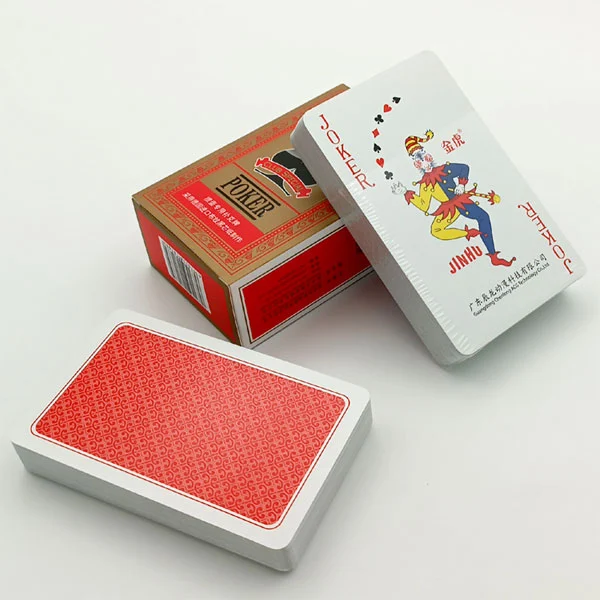
At 2.5" × 3.5" (63.5 × 88.9 mm), poker size provides a useful reference point for many custom card projects. The format gives designers enough space for conventional playing-card indices, illustrations, icons, or game information without moving into an oversized format.
For a new project without a strong reason to use a specialized format, poker dimensions can therefore be included among the first prototypes to test. Designers can print paper mockups at actual size and evaluate them with real players before committing to the production layout.
Chenlong's custom playing cards page can be used as the primary product reference when discussing a poker-sized or other custom card format.
Bridge Size: Same Height, Narrower Hand
Bridge cards use the same 3.5" height as poker cards but reduce the width from 2.5" to 2.25". That narrower format can be useful when players routinely hold many cards at once.
This does not mean every game with a large hand should automatically use bridge dimensions. A narrower card also provides less horizontal design space. If a card contains multiple icons, rules text, large illustrations, or wide graphical elements, the designer needs to check whether the reduced width creates unwanted compromises.
The practical question is therefore not simply poker size vs bridge size. It is whether the game benefits more from additional artwork width or from a narrower fan of cards in the player's hand.
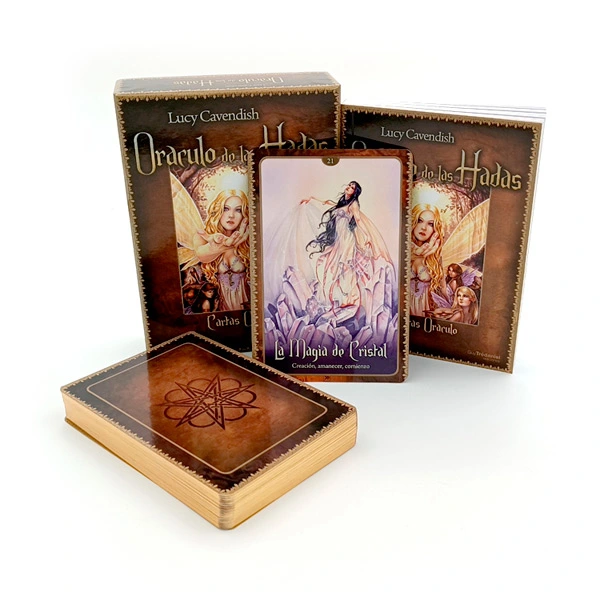
Tarot Size: More Space for Artwork
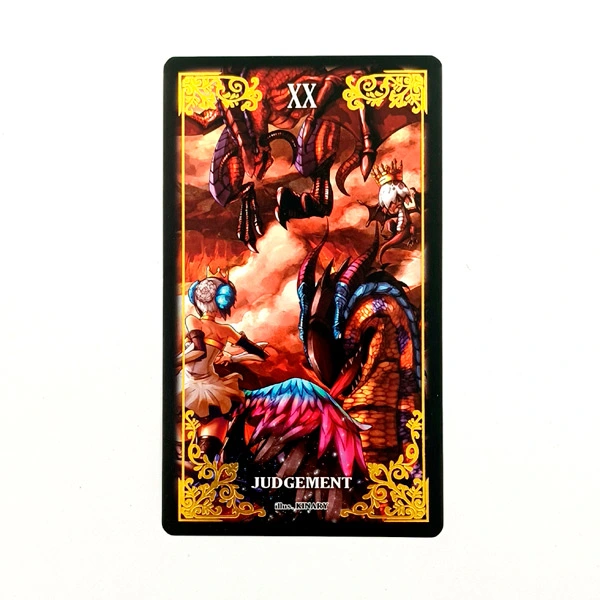
Tarot cards at 2.75" × 4.75" (70 × 120 mm) provide substantially more vertical artwork space than poker or bridge formats. This makes the format particularly relevant when each card acts as an illustration, symbolic object, or visual centerpiece rather than only an information carrier.
The trade-off is physical scale. A larger card requires more table area and a larger package. A large hand of tarot-sized cards may also feel different from a hand of poker-sized cards. Designers should therefore choose the format because the artwork or intended interaction justifies it, not simply because larger cards appear more premium.
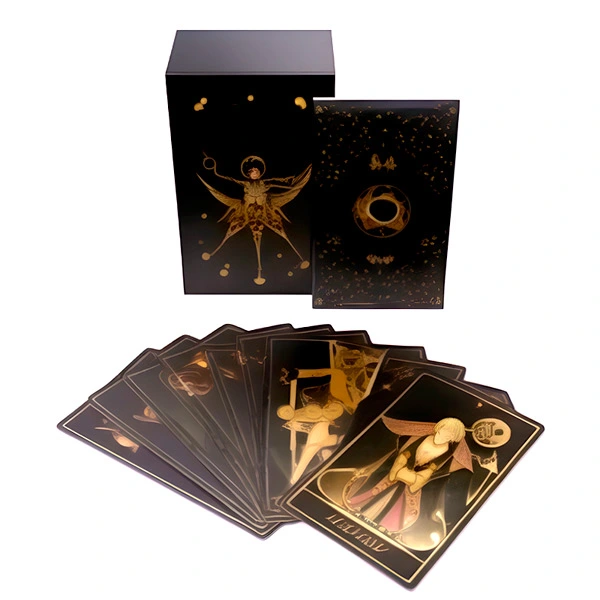
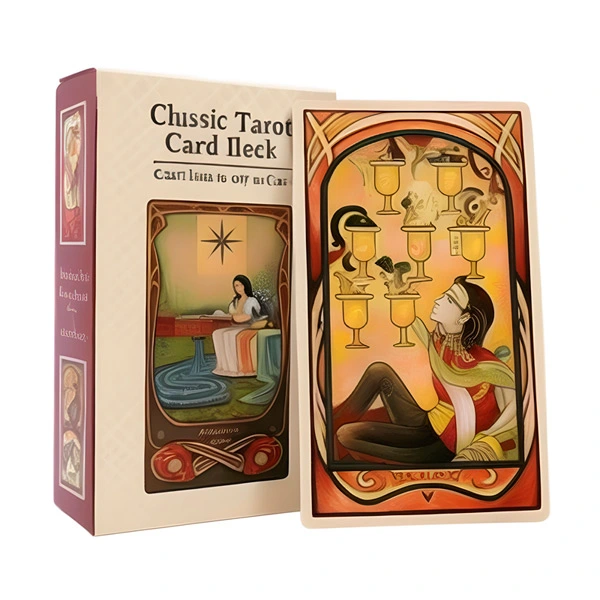
Creators working with this format can also review Chenlong's custom tarot card category when planning an illustration-heavy deck.
Mini Cards: Compact but Less Forgiving
Mini cards at 1.75" × 2.5" (44.45 × 63.5 mm) dramatically reduce the footprint of a card. That can be valuable for compact tabletop layouts, travel products, small inserts, promotional concepts, or games where cards behave more like tokens or reference pieces than conventional hand-held playing cards.
The design challenge is information density. Text, icons, borders, and illustrations all have less physical space. A layout that works on a poker card may become unreadable if reduced proportionally onto a mini card.
Always test mini-card artwork at 100% physical size. Zooming into the file on a monitor can hide readability problems that become obvious immediately on paper.
Square and Jumbo Formats
Square cards create a noticeably different visual system because the designer is no longer working with the familiar portrait rectangle. They may suit games in which cards are placed into spatial patterns, tiles, grids, or tabletop arrangements. Whether a square format improves gameplay depends on the specific product.
Jumbo cards move in the opposite direction from mini cards. More physical area can support large illustrations, demonstrations, educational content, or visibility-oriented applications, but the format also increases the space required for storage and table use.
3. How Size Affects Cost
It is tempting to assume that card manufacturing cost increases in direct proportion to card area. In practice, quotations depend on the complete production specification, including material, quantity, printing, finishing, cutting, sheet arrangement, packaging, and manufacturing workflow. Exact cost relationships require a project-specific quotation.
However, size can influence several parts of that cost structure.
Paper or Cardstock Utilization
Cards need to be arranged on larger production sheets or within another manufacturing layout. Changing the card dimensions changes how many cards can fit within that layout and how efficiently the available material is used.
A smaller card does not automatically guarantee a proportional cost reduction because production efficiency depends on the complete imposition and manufacturing setup. Likewise, a relatively small increase in card width can potentially change the optimal production arrangement. Exact sheet yields should therefore be calculated by the manufacturer.
Cutting and Tooling
Standard dimensions may align with tooling or established production workflows available from a supplier, while a completely custom shape or size may require additional setup or tooling. Exact tooling requirements and charges depend on the project.
This does not mean designers should avoid custom dimensions. If an unusual card size materially improves the game, the design benefit may justify it. The important step is to request the cost impact before the packaging and artwork are locked.
Artwork and Finishing Area
A larger card provides a larger printable surface. If the project also uses foil stamping, UV treatment, lamination, special coatings, or other finishes, the finished dimensions may influence the material or process requirements. Exact cost relationships depend on the chosen finish.
Packaging Cost
Card size directly determines the minimum internal footprint of the package. Tarot cards cannot fit a poker-sized tuck box, and square cards require a package designed around their different proportions.
The number and thickness of the cards then determine the required depth. That makes card size and card stock inseparable from packaging engineering.
| Size Decision | Possible Production Effect | What to Ask During RFQ |
|---|
| Move from Bridge to Poker | Wider card footprint and wider package | Does the width change sheet utilization, tooling, insert or box dimensions? |
| Move from Poker to Tarot | Greater card area and larger packaging footprint | How does the larger format affect material use and packaging quotation? |
| Move from Poker to Mini | Smaller footprint but potentially different production layout | Does the smaller format actually reduce unit cost at the required quantity? |
| Choose a Custom Size | May affect tooling, layout, packaging and production setup | Is new tooling required, and what is the recommended production size closest to the design goal? |
4. Matching Card Size to Game Type
The most useful way to choose playing card dimensions is to start with what players need to do with the cards. The following table is a decision aid rather than a mandatory standard.
| Game or Product Scenario | Format to Evaluate First | Reason | Main Trade-off to Test |
|---|
| Players hold many cards simultaneously | Bridge — 2.25" × 3.5" | Narrower card width reduces the width of a fanned hand. | Less horizontal area for artwork and information. |
| General card game | Poker — 2.5" × 3.5" | Useful general-purpose reference with familiar proportions. | Confirm whether the card contains more information than the format comfortably supports. |
| Trading-card-style game | TCG reference — approximately 63 × 88 mm | Close to the familiar poker/TCG footprint. | Final dimensions should be fixed before designing packaging or compatibility-dependent accessories. |
| Tarot or art-focused deck | Tarot — 2.75" × 4.75" | Greater surface area for artwork and symbolic detail. | Larger hand, table footprint and packaging. |
| Compact board game component | Mini — 1.75" × 2.5" | Reduces physical footprint. | Text and icon readability at the smaller scale. |
| Spatial or tile-like card system | Square — 3" × 3" | Square proportions can support grid-oriented or non-traditional layouts. | Different hand feel and custom packaging footprint. |
| Large visual or demonstration card | Jumbo — define exact size | Provides greater visual area and visibility. | Jumbo is not one universal dimension; specify 3.5" × 5", 4" × 6", or another approved format explicitly. |
A Simple Designer Decision Flow
Step 1: Determine the maximum number of cards a player is likely to hold.
Step 2: Determine how much text, iconography, and illustration must appear on each card.
Step 3: Print poker, bridge, tarot, or other candidate layouts at actual physical size.
Step 4: Test the cards during real gameplay rather than reviewing them only on screen.
Step 5: Check the proposed size against card count, cardstock thickness, insert, and package.
Step 6: Ask the manufacturer whether the selected size changes tooling or production efficiency.
Step 7: Freeze the finished card dimensions before finalizing the dieline and packaging.
If the product follows a conventional poker format, Chenlong's poker card category provides another relevant product reference.
5. Preparing Print Files
Once the finished dimensions are approved, the designer needs to translate them into a production file. Finished size, bleed, safe area, resolution, and rounded corners should be treated as separate concepts.
Finished Size vs. Bleed Size
The final card dimensions are measured at the trim line. According to the approved Print247 reference, designers can plan around 0.125" of bleed on each side.
For a poker card:
Finished size: 2.5" × 3.5"
With 0.125" bleed on all four edges: 2.75" × 3.75"
Finished-size artwork at 300 DPI: 750 × 1050 px
Bleed-file pixel dimensions at 300 DPI: 825 × 1125 px
For bridge size:
Finished size: 2.25" × 3.5"
With bleed: 2.5" × 3.75"
Finished-size artwork at 300 DPI: 675 × 1050 px
Bleed-file pixel dimensions at 300 DPI: 750 × 1125 px
For tarot size:
Finished size: 2.75" × 4.75"
With bleed: 3" × 5"
Finished-size artwork at 300 DPI: 825 × 1425 px
Bleed-file pixel dimensions at 300 DPI: 900 × 1500 px
These calculations are based on the approved 0.125" bleed reference. The manufacturer's own artwork template should take priority if its requirements differ.
Safe Area
The approved Print247 source also recommends keeping important text and logos approximately 0.125" inside the trim line. Background colours and artwork can extend into the bleed, but critical information should not depend on an exact cut position.
This is particularly important for card borders. A narrow symmetrical frame can make small cutting variation visually obvious. Cutting tolerances are project-specific and should be taken from the manufacturer's production template.
Rounded Corners
A typical playing-card rounded-corner reference in the approved source is approximately 1/8", or around 3–4 mm. Designers should not manually assume that every card format uses exactly the same radius, however. Confirm the final cutting die or manufacturer's template before finalizing artwork close to the corners.
300 DPI Is Not the Same as Physical Size
Pixel dimensions only become meaningful when paired with a resolution. A file that is 750 × 1050 pixels corresponds to a 2.5" × 3.5" finished poker card at 300 pixels per inch.
Designers should therefore keep the physical dimensions in the production specification even when supplying raster artwork. Do not describe the requested card only as “750 × 1050 pixels” without also stating that the finished card must be 2.5" × 3.5".
6. Packaging Implications
A card box cannot be designed correctly from card width and height alone. The internal dimensions also need to accommodate the total thickness of the finished deck.
Start With Three Variables
Card width and height: Determine the basic internal footprint.
Number of cards: Determines how many layers are stacked into the package.
Finished card thickness: Combined with card count, determines the approximate deck thickness.
A basic planning relationship is:
Approximate deck thickness = number of cards × finished thickness per card.
This calculation can provide a starting reference, but the finished packaging specification also needs appropriate manufacturing clearance, material tolerances, coatings, wrapping, inserts, and other project variables. The exact internal clearance should be supplied or approved by the packaging manufacturer.
Why You Should Not Design the Box First
Suppose the packaging team creates a tuck box before cardstock and card count are final. If the deck later gains additional cards or moves to a different stock thickness, the original box depth may no longer be appropriate.
The same problem can occur in board games with molded or paper inserts. A card well designed around poker cards cannot automatically accommodate tarot cards, and a bridge-sized compartment may be too narrow if the project later changes to poker dimensions.
The safer sequence is:
Finalize or closely estimate card count;
Choose the finished playing card size;
Select and sample the cardstock;
Measure or calculate the finished deck;
Design the tuck box, rigid box, or insert around the approved deck;
Test the complete physical package before mass production.
Larger Cards Do Not Only Need a Larger Front Panel
Moving from poker to tarot dimensions changes the entire package footprint. The front and back panels grow, but so do the opening, side structure, insert dimensions, and any surrounding board game packaging designed to hold the card box.
Moving to square cards creates another packaging change because the aspect ratio is different. If the cards sit inside a larger board game box, the altered footprint can affect the arrangement of nearby boards, tokens, dice, instructions, or miniatures.
This is why card-size decisions are best made alongside packaging decisions rather than several stages apart.
7. FAQ
What is the standard playing card size?
Poker size is commonly used as the standard reference and measures 2.5" × 3.5", or 63.5 × 88.9 mm. Other established formats include bridge at 2.25" × 3.5", tarot at 2.75" × 4.75", and mini at 1.75" × 2.5". The correct format depends on the game rather than on one universal rule.
What is the difference between poker size and bridge size cards?
Poker cards measure 2.5" × 3.5", while bridge cards measure 2.25" × 3.5". They have the same height, but bridge cards are 0.25" narrower. That difference can make a large hand of cards more compact, while poker size provides slightly more horizontal artwork space.
What is the standard TCG card size?
The approved sources use a trading-card or MTG-style reference of approximately 63 × 88 mm, close to the conventional poker footprint of 63.5 × 88.9 mm. If compatibility with sleeves, packaging, or another existing card system is essential, confirm the exact finished dimensions rather than relying on the general label “TCG size.”
How much bleed should I add to playing-card artwork?
The approved Print247 reference recommends 0.125" bleed on each edge and a 0.125" safe margin inside the trim. For example, a 2.5" × 3.5" poker card becomes a 2.75" × 3.75" artwork file when that bleed is added. Always check the manufacturer's actual template before releasing final production files.
Choose the Size Before You Build the Packaging
The best playing card dimensions are not simply the ones most commonly used. They are the dimensions that support the way players hold and use the cards, provide enough room for artwork and information, fit the intended production method, and work efficiently with the final package.
Guangdong Chenlong ACG Technology Co., Ltd. states that it operates a 30,000㎡ factory with more than 200 employees, uses Heidelberg printing equipment, reports annual output value above RMB 300 million, and provides an R&D laboratory and Digitalised Production for Small Orders. Its product range includes playing cards, poker cards, tarot cards, board game cards, PVC playing cards, and related tabletop components.
If you are planning a new card product, send your selected card dimensions, card count, material requirement, artwork status, and expected production quantity to info@chenlong-acg.com, or visit Chenlong's Playing Card product page to discuss a project-specific quotation. If you are still deciding between poker, bridge, tarot, mini, square, or another custom format, include your gameplay and packaging requirements so the size decision can be evaluated before the final dieline is prepared.





.jpg "Personalized Play: Crafting a Unique Narrative with Custom Board Game Playmats")