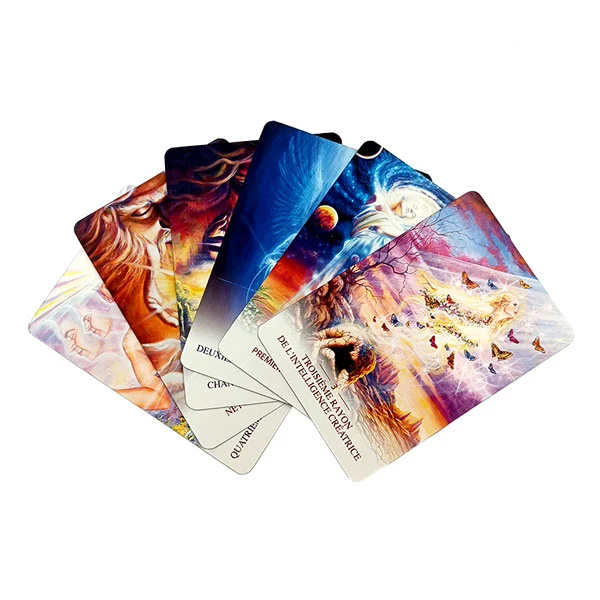
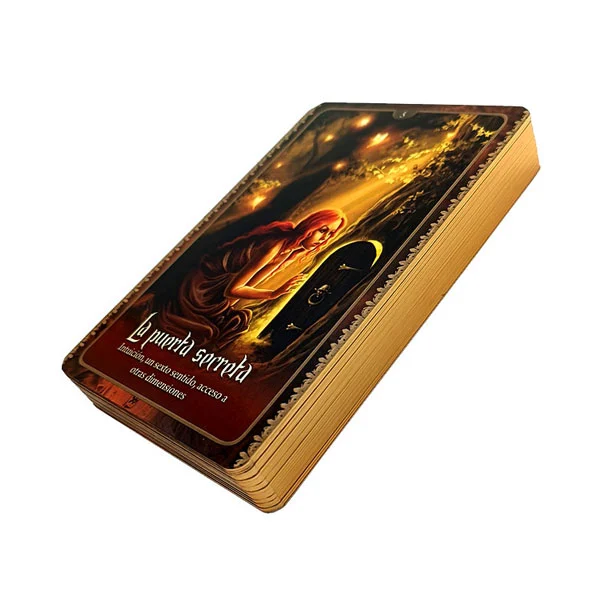
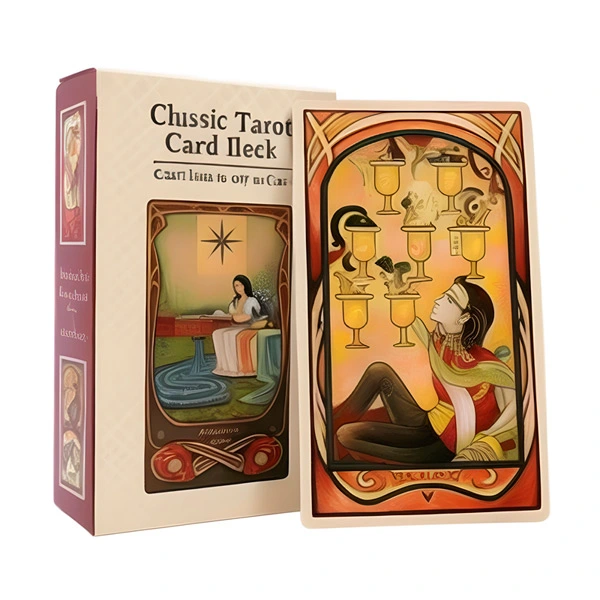
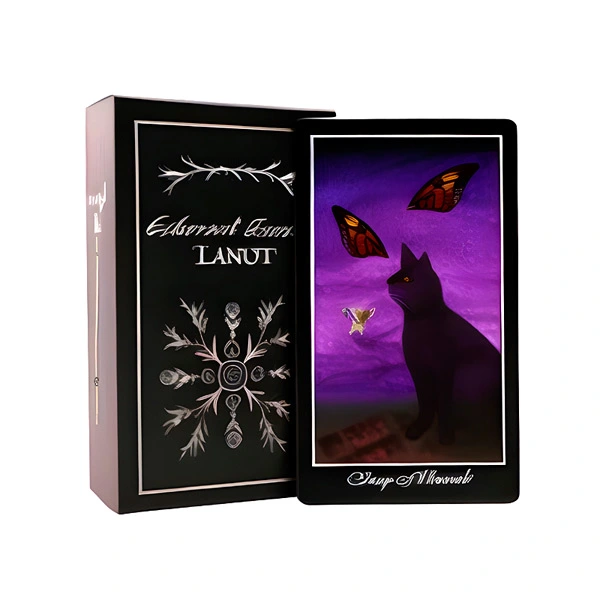
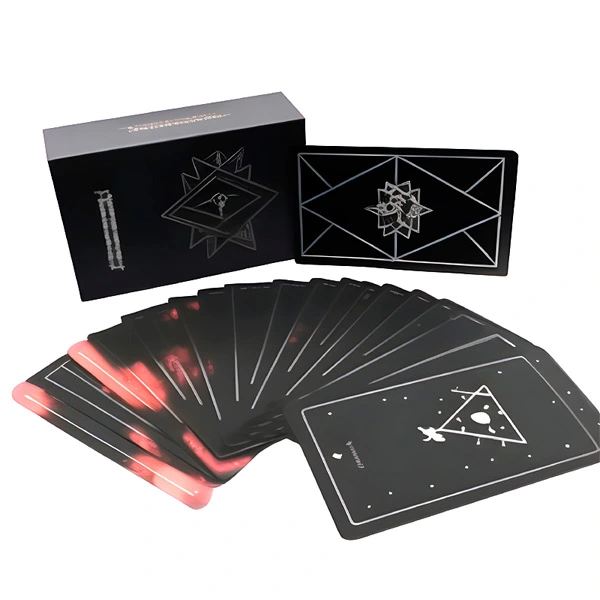
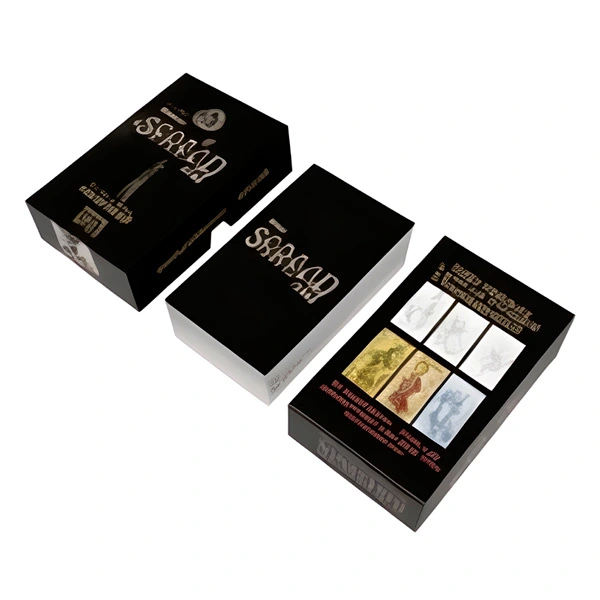
Gold can appear on a card deck in several very different ways. A title may be stamped with metallic foil, the edges of an entire deck may receive a gold-coloured finish, or the card surface itself may be designed to create an extensive metallic appearance. Although these products may all be marketed as gold playing cards, they do not use the same production process and should not be specified in the same way.
For tarot publishers, collectible playing-card brands, crowdfunding creators, and promotional buyers, the first sourcing question should therefore be: Where do you want the metallic effect to appear? The answer determines the artwork preparation, card construction, proofing method, production complexity, and quotation.
This guide explains the differences between gold foil playing cards, gilded card edges, and gold-plated or metallic-surface card concepts. It also covers artwork preparation, process compatibility, proofing, and the information buyers should provide when requesting a custom quotation.
1. Why Gold Finishes Command Premium Prices
A gold effect changes how a card deck is perceived before the cards are even played or read. Metallic highlights can emphasize a logo, border, illustration, symbol, or card title, while gilded edges can turn the complete deck into a visually unified object when viewed from the side.
This makes metallic finishing particularly relevant to products where presentation is part of the buying decision: premium tarot decks, collectible playing cards, limited editions, crowdfunding rewards, gift products, and branded promotional decks.
From a manufacturing perspective, however, a metallic effect is not simply another printed colour. Depending on the selected process, it may require a separate production stage, dedicated artwork, process-specific tooling, additional setup, extra handling, or more detailed inspection. The exact cost effect depends on the process, artwork coverage, card construction, quantity, finishing combination, and production specification.
This is why two decks that both appear “gold” can have very different quotations. One project may use a small foil-stamped logo on the card back. Another may use foil on multiple faces, gilded edges, and a coordinated metallic box. A third may use a card construction designed to create a metallic appearance over a much larger area.
Rather than asking only, “How much do gold cards cost?”, buyers should define:
Where the gold effect appears;
How much of the artwork requires a metallic finish;
Whether the front, back, edges, or multiple areas are involved;
Whether the gold effect needs to be combined with normal printed colours;
The card material and construction;
The finished card size;
The number of cards per deck;
The required production quantity;
Whether matching metallic effects are required on the box or other components.
For projects already considering a premium tarot format, Chenlong's Golden Tarot product page provides a relevant internal reference for discussing a project-specific metallic card specification.
2. Foil Stamping vs. Gilded Edges vs. Gold-Plated Cards
The most important distinction is between metallic decoration applied to selected artwork areas, metallic finishing applied to the edges of the deck, and broader metallic surface treatments. These processes create different visual results and require different production planning.
| Finish Type | Where the Effect Appears | Basic Process Direction | What the Buyer Should Confirm |
|---|
| Foil Stamping | Selected areas of the card face, card back, box, or other printed component | Metallic foil is transferred to defined artwork areas using heat, pressure, and a metal die. | Foil colour, artwork coverage, compatible substrate, die requirements, registration expectations, and whether foil is applied to one or multiple sides. |
| Gilded Edges | The exposed edges of the complete card deck | A metallic finish is applied to the card edges after the deck has been prepared as a stack. Exact application methods vary by specification. | Edge colour, card construction, deck thickness, edge preparation, expected appearance, durability criteria, and packaging protection. |
| Gold-Plated / Metallic-Surface Cards | A large portion of the card surface or an overall metallic visual structure | The exact construction depends on the supplier and product. The phrase “gold-plated” should not automatically be interpreted as literal precious-metal plating without a verified material specification. | Actual material structure, metallic layer, printing method, flexibility, surface finish, card handling, colour appearance, and production terminology. |
Foil Stamping: Metallic Detail in Selected Areas
Foil stamping is useful when the design requires metallic emphasis rather than a metallic effect across the entire card. A publisher might apply foil to a deck title, decorative frame, icon, constellation, character symbol, card-back pattern, or selected illustration detail.
The general principle is straightforward: a metal die defines the foil area, and heat and pressure transfer the foil onto the selected surface. Because the foil layer is controlled separately from ordinary printed artwork, the designer must prepare it as its own production element.
Foil stamping should therefore be planned during artwork development rather than added as a vague instruction at the end of the project. Small details, fine lines, large solid areas, nearby printed graphics, and repeated patterns can all create different manufacturing considerations. Exact minimum line widths, registration tolerances, and recommended foil coverage require process-specific verification.
Gilded Edges: Metallic Colour Around the Deck
Gilding changes the appearance of the deck from the side. When the cards are stacked together, the finished edges create a continuous metallic visual effect. After individual cards are separated during use, the metallic treatment remains visible along their edges.
This makes gilded edges particularly useful when the publisher wants the deck itself to feel visually distinctive even before the first card is drawn.
Edge gilding is different from placing foil artwork on the face of a card. It is a deck-level finishing process, so card construction, trimming, surface treatment, stacking, edge preparation, and packaging can all matter to the final result. Exact process details, durability, allowable variation, and compatibility with different cardstocks require confirmation from the manufacturer.
Buyers should also distinguish between a visual sample and a production acceptance standard. Metallic edges can look different depending on viewing angle, light, surface preparation, and card separation. Project-specific expectations should be reviewed on an appropriate physical sample before mass production.
What Does “Gold-Plated Playing Cards” Mean?
The term gold plated playing cards can be ambiguous in sourcing discussions. A product marketed as “gold-plated” may refer to a metallic-looking surface construction rather than literal plating with precious gold. The exact material and process must therefore be confirmed with the supplier.
This distinction matters commercially. A buyer sourcing a promotional metallic deck, a luxury tarot product, and a product that makes a specific material-content claim may require very different documentation and manufacturing specifications.
Instead of sending only the phrase “gold-plated cards,” provide a reference image and ask the manufacturer to define the proposed construction. Confirm what the metallic layer actually is, how normal artwork is applied, whether both sides can be decorated, how the cards handle, and what sample should be approved before production.
3. Process × Cardstock × Quantity Compatibility
Metallic finishing cannot be selected independently from the base card. Cardstock, surface coating, lamination, card size, deck thickness, and other construction variables may influence which finishing methods are suitable. Exact compatibility ranges require project-specific technical verification.
| Project Variable | Why It Matters | What to Confirm |
|---|
| Cardstock / Card Construction | The metallic process must be compatible with the selected card surface and construction. | Available stocks, surface treatments, foil compatibility, edge-finishing suitability, and physical sample options. |
| Card Thickness or Weight | The finished card structure may affect deck thickness, handling, cutting, edge finishing, and packaging. | Suitable specification range and whether the selected finish changes the recommended card construction. Specific numbers require confirmation. |
| Card Size | Standard and custom formats may have different tooling, imposition, finishing, or handling requirements. | Maximum and minimum compatible sizes for the chosen process. |
| Artwork Coverage | A small logo and a large metallic illustration do not create the same production requirement. | Recommended foil area, fine-detail limits, large solid areas, and registration-sensitive elements. |
| Quantity | Some processes involve setup, tooling, or production stages that change the quotation structure. | MOQ, quotation tiers, sample method, tooling charges, and quantity-specific process recommendations. |
Do Not Choose the Cardstock After Choosing the Finish
A common sourcing mistake is to complete the card artwork, select a preferred paper specification, and only then ask whether foil or gilding can be added. A more efficient sequence is to define the desired visual result first and let the card construction and metallic process be evaluated together.
For example, if a golden tarot deck requires normal full-colour illustration, metallic highlights on selected symbols, and gold-coloured edges, the manufacturer needs to consider the complete combination rather than three unrelated specifications.
The quotation and sample should therefore identify the entire construction: card material, printing, surface finish, foil areas, edge treatment, card size, number of cards, and packaging.
Quantity Can Change the Production Decision
Quantity matters because a prototype, crowdfunding test run, promotional order, and established retail production run may justify different production routes. MOQ thresholds and quantity economics vary by process combination and should be settled during quotation.
Chenlong states that it provides Digitalised Production for Small Orders. This makes small-order requirements relevant to an initial sourcing conversation, but it does not establish a universal MOQ for every gold foil, gilded, or metallic card specification.
When requesting a quote, provide realistic quantity scenarios instead of assuming that one process will remain equally suitable at every volume.
4. Preparing Artwork for Foil
Foil artwork should be treated as manufacturing information, not just visual artwork. The production file must clearly distinguish the metallic area from normal printed graphics.
Create a Separate Foil Layer
The areas that receive foil should be isolated on a separate artwork layer or file according to the manufacturer's requirements. Designers commonly identify the foil area with a dedicated spot colour or clearly named production layer. Exact file conventions should be confirmed with the manufacturer before final files are supplied.
A useful file structure may distinguish:
Normal CMYK or other printed artwork;
Foil stamping areas;
Cutting or finished-size information;
Other special finishes, if applicable;
Front and back artwork;
Packaging artwork using related metallic treatments.
The important point is that the manufacturer should never need to guess which gold-coloured graphic on screen represents actual metallic foil and which area is simply printed yellow or gold.
Do Not Simulate Foil With a Printed Gradient
A metallic effect shown in a digital mock-up does not itself provide usable foil-production information. If a designer uses gradients, highlights, shadows, or texture to simulate metallic reflection, those visual effects must still be translated into a clear production specification.
For true foil-stamped areas, the manufacturer needs to know exactly where foil should be transferred. If printed artwork also appears inside or around the foil area, the interaction between the two should be discussed during prepress review.
Confirm Fine Detail Before Finalizing Artwork
Highly detailed tarot artwork can contain thin lines, stars, ornamental borders, small lettering, geometric patterns, or fine symbolic elements. Not every detail that appears clearly in a digital file will necessarily behave the same way during a metallic finishing process.
Minimum line width, spacing, knockout detail, foil registration tolerance, and recommended distance from cut edges have not been verified. The safer workflow is to submit representative artwork before finalizing the entire deck and ask whether any details need adjustment.
Bleed and Safe Areas Still Matter
Standard print preparation still applies around metallic finishing. Card artwork must account for trimming and safe areas, while foil artwork may need additional restrictions depending on its position and production method. Exact bleed measurements and foil-to-cut distances must come from the manufacturer's current production template.
Publishers working with multiple premium finishes should maintain clear version control. A file named simply “final” is not sufficient when several revisions exist. Use identifiable version numbers for print artwork, foil layers, card backs, packaging, and other production files.
5. Proofing and Risk Control in Bulk Production
Metallic finishes are especially difficult to approve from a screen because their appearance changes with light, viewing angle, substrate, and surface treatment. A digital proof can confirm layout, but it cannot fully represent the physical metallic effect.
For this reason, proofing should focus on the questions that could create expensive changes after production begins.
What to Check on a Physical Sample
Foil position: Confirm that metallic elements align acceptably with nearby printed artwork.
Foil detail: Check small symbols, thin lines, lettering, and ornamental patterns.
Solid areas: Review larger foil areas for the expected visual result.
Card flexibility and handling: Evaluate the complete finished construction rather than only the decorative layer.
Gilded edges: Inspect the deck as a closed stack and after individual cards are separated.
Colour combination: Check whether metallic elements work with the surrounding printed colours.
Packaging: Make sure the finished deck fits the intended box after all card and edge treatments are included.
Define Approval Criteria Before Mass Production
Statements such as “make the gold more premium” are too subjective for production approval. Buyers should identify the sample or written specification that controls the final result.
If colour, metallic tone, registration, edge appearance, or another feature is especially important, state that requirement before the production order is released. Industrial tolerances and acceptable variation should be agreed with the manufacturer during sampling.
Avoid Changing Multiple Variables After Approval
A sample should represent the intended combination as closely as practical. If the card material, surface finish, foil, artwork, or edge treatment changes after approval, the final result may no longer match the approved sample.
Where changes are necessary, identify which variables changed and ask whether another confirmation sample is appropriate.
Check the Whole Product, Not Only the Cards
A premium deck is often purchased as a complete object. The cards, box, booklet, insert, and other components should therefore be reviewed together. Metallic decoration on the cards may be combined with related artwork or finishing on the package, but compatible processes and exact results require project-specific confirmation.
Chenlong lists Golden Tarot, Rainbow Foil Tarot, and Black Silver Plated Tarot among its tarot-related product lines. Publishers exploring a broader metallic aesthetic can also review the Rainbow Foil Tarot category when discussing alternative foil directions.
6. Recommended Combinations by Use Case
There is no single “most premium” finishing combination. The best specification depends on what the customer should notice first, how the deck will be used, and how much manufacturing complexity is justified by the product positioning.
Luxury Tarot Deck
For a premium tarot product, the metallic finish can be integrated with the visual language of the illustrations rather than added uniformly to every available area.
A possible sourcing direction is:
Full-colour tarot artwork;
Selected foil-stamped symbols, frames, titles, or card-back elements;
Gold-coloured gilded edges;
Coordinated premium packaging.
The technical compatibility of these processes and the exact suitable card construction must be confirmed during sampling.
This approach may be more effective visually than applying metallic decoration to every element because it allows the foil to create hierarchy. Publishers can use the Golden Tarot product page as the main Chenlong contact point for a custom project discussion.
Collectible Playing Cards
For collectible playing cards, the card back often provides a strong opportunity for metallic detail because it repeats consistently across the deck. Foil can also be considered for selected tuck-box or rigid-box artwork, while gilded edges can create a distinctive appearance when the deck remains stacked.
A possible brief might therefore specify normal printed faces, a foil-enhanced card back, gilded edges, and matching packaging. The exact production route depends on card material, artwork, quantity, and finish compatibility.
If a project is closer to a conventional poker or playing-card format than a tarot deck, Chenlong's playing card category can be included in the sourcing discussion.
Promotional and Corporate Gift Decks
Promotional buyers often need the metallic element to emphasize brand recognition rather than complex illustration. A restrained foil treatment on a logo, emblem, slogan, card back, or package may communicate the desired premium effect without requiring metallic treatment across every card surface.
The purchasing team should define where metallic finishing creates actual branding value and compare quotation options for different process combinations rather than automatically selecting the maximum number of finishes.
Crowdfunding Special Edition
A special crowdfunding edition may use metallic finishing to create a visible distinction from the standard edition. Instead of redesigning the entire product, the publisher can identify a limited set of differentiating features such as alternative foil, gilded edges, special card backs, or upgraded packaging.
Separate the standard and special-edition specifications clearly so the manufacturer can quote each configuration accurately. MOQ, tooling, and quantity economics are project-specific.
7. FAQ
What is the difference between gold foil playing cards and gilded cards?
Gold foil normally refers to metallic foil transferred onto selected areas of the card face, card back, or packaging using a die, heat, and pressure. Gilding refers to a metallic finish applied to the exposed edges of the deck. A deck can use either process independently or potentially combine them, subject to manufacturing compatibility. Exact combination requirements should be confirmed with the manufacturer.
Are gold-plated playing cards made with real gold?
Do not assume that they are. The term “gold-plated” can be used commercially for different metallic-looking card constructions, and the exact material has not been standardized within the approved source information. If actual material composition matters to your product claim, ask the supplier for a written specification rather than relying on the product name.
Can foil stamping and gilded edges be used on the same tarot deck?
They can be considered as separate finishing elements within the same design concept, but compatibility depends on the card construction, surface treatments, artwork, finishing sequence, and production method. The safest approach is to request a sample that represents the intended combination rather than approving the finishes independently.
What information do I need for a gold foil card quotation?
Provide the card size, card material if already selected, number of cards per deck, artwork, exact foil areas, whether foil is required on one or both sides, whether edge gilding is required, packaging requirements, total order quantity, destination, and target schedule. If you want a broader metallic or “gold-plated” card appearance, provide a visual reference and ask the manufacturer to define the proposed material construction.
Plan the Finish as Part of the Card Construction
The safest way to source a golden deck is to avoid treating “gold” as one generic finish. Decide whether the metallic effect belongs in selected artwork areas, around the edges of the deck, across a larger card surface, or in a combination of these locations. Then evaluate the card construction, artwork, finishing method, packaging, quantity, and proofing plan together.
Guangdong Chenlong ACG Technology Co., Ltd. states that it operates a 30,000㎡ factory with more than 200 employees, uses Heidelberg printing equipment, reports annual output value above RMB 300 million, and provides an R&D laboratory and Digitalised Production for Small Orders. Its listed product range includes Golden Tarot, Rainbow Foil Tarot, Black Silver Plated Tarot, playing cards, PVC playing cards, board game components, and related printed products.
If you are developing golden tarot cards, collectible playing cards, a crowdfunding special edition, or a promotional deck, send your proposed card size, metallic finishing combination, artwork, number of cards, and expected order quantity to info@chenlong-acg.com. You can also visit the Golden Tarot product page to discuss a project-specific sample and quotation.